Title here
Summary here
To access the Invoices page, use the
The invoice list displays a list of all the supplier invoices recorded in the system. From here you can view and edit invoices and raise new customer invoices.
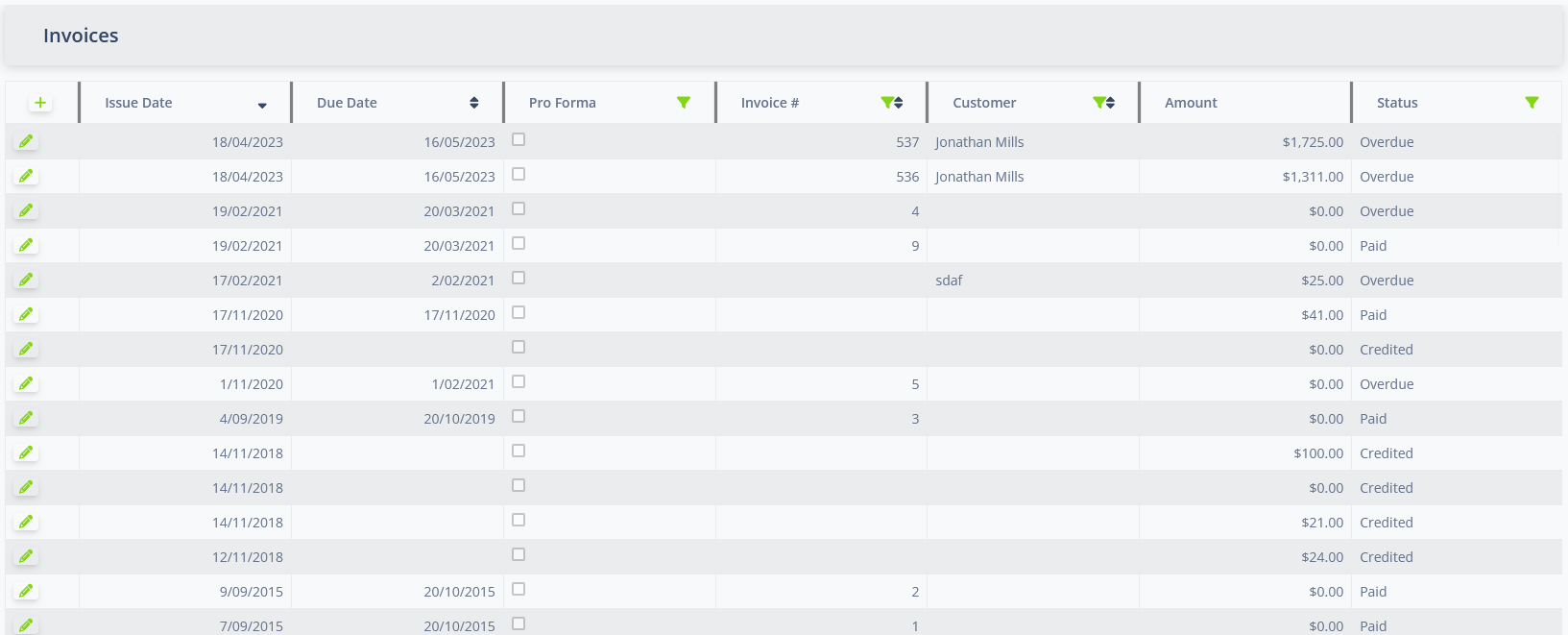
| Field | Meaning |
|---|---|
| Issue Date | Date the invoice was raised. |
| Due Date | Last date for payment for the invoice. |
| Pro Forma | The pro-forma status of the invoice. |
| Invoice # | The invoice number. |
| Customer | The Other Party that the invoice was raised too. |
| Amount | Total amount due, including tax. |
| Status | Payment status of the invoice. |
The Invoices List follows the standard List Page Actions paradigm.
The edit action and create action will open the Invoice Editor.
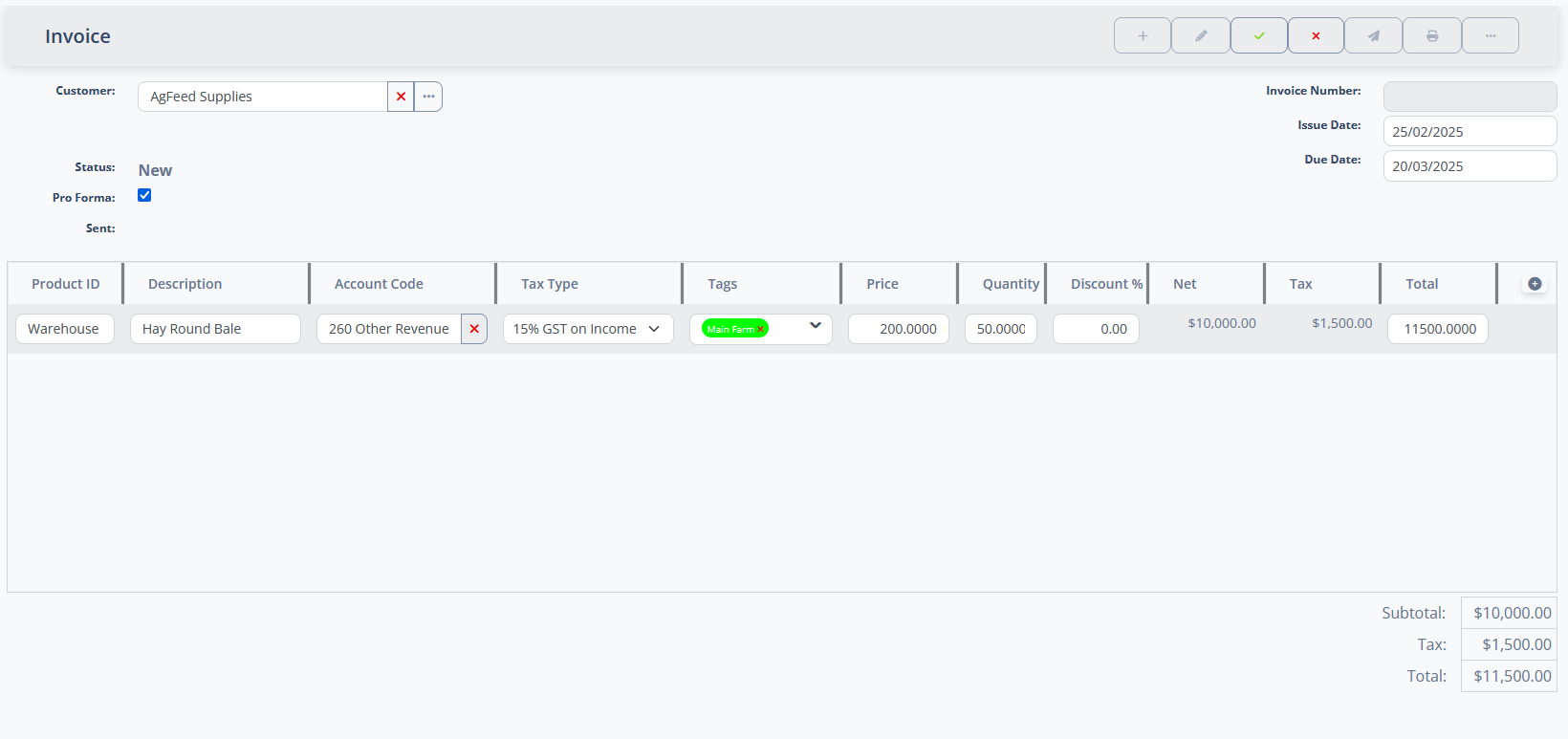
The invoice details panel contains the basic information about the invoice:
| Field | Definition |
|---|---|
| Customer | The Other Party record of the customer that the invoice is raised for. [type-ahead] |
| Status | The current status of the bill. |
| Pro Forma | The pro-forma status of the bill. |
| Invoice Number | The invoice number. |
| Issue date | Date the invoice was raised. |
| Due date | Last date the payment is expected for the invoice. |
An invoice can be marked as “Pro Forma”. This means that it is a draft invoice, and values from it will not be included in any financial statements, reports or in payments reminders on the Dashboard.
When you start to create a new invoice, it will be marked as Pro Forma by default, and no invoice number will be assigned to it. An invoice number is only generated once an invoice is issued, that is, when it is saved without the Pro Forma status checked. You can uncheck the Prof Forma check-box before you save it, or you can use the Issue action to remove the Pro Forma state.
Once an invoice has been issued, it cannot be moved back to the Pro Forma state, nor can it be deleted. It may be credited if it was issued in error or re-issued if a changed needs to be made.
The Status field displays a simple overview of the financial state of the invoice. These are the possible statuses for an invoice:
| Status | Meaning |
|---|---|
| New | The invoice is being edited and has not been saved yet. |
| Paid | The invoice has been paid in full. |
| Due | The invoice has not been paid in full yet, and the Due date is in the future. |
| Overdue | The invoice has not been paid in full yet, and the Due date is in the past. |
The invoice line items record details of individual items in the customer invoice. Each line item is backed by a External Transaction that records the financial impact of the line item.
| Field | Definition |
|---|---|
| Type | Drop-down list of the available line item types. |
| Item | The entity that this line item relates to. This value and input field depends of the value of the Type field, as described below. |
| Batch | When a Stock Item is selected in the Item field, the Batch provides a way to specify the batch of product from which the stock items are sold. [type-ahead] |
| Account Code | The Account Code that the line item transaction will be posted to. [type-ahead] |
| Tax Type | The sales tax rate that applies to the line item. |
| Tags | Financial tags that apply to the line item. |
| Price | Per-unit cost of the line item, exclusive of tax. |
| Quantity | Number of units of the line item. |
| Discount % | Discount percent applied to the line item. |
| Net | Calculated total cost for the line item, exclusive of tax. |
| Tax | Calculated tax amount for the line item. |
| Total | Total value for the line item, inclusive of tax. |
| Adds a new, blank line item. A line item may be deleted using the action. |
Note
The total value will be re-calculated when there are changes to the Price, Quantity Discount % and Tax Type fields. If a new value is entered in the Total field, the system will re-calculate the Price field to balance the equation.
In iAgri, invoice line items can be linked to the item that caused the financial transaction. This is part of what enables iAgri to track expenditure very closely to produce accurate reports and forecasts of your farm’s financial performance. The line item type determines what type of items can be linked to the line item.
The following types are supported:
The line item has no related entity and the item is a simple textual description. Use this if there is no item in iAgri this transaction relates to.
The line item is related to a Stock Item in the system. The Item field will be a type-ahead field that allows you to select a stock item. Selecting a stock item will cause the Account Code, Tax Type and Price fields of the line item to be populated from the stock item if they are defined there.
When the invoice is issued, a corresponding Warehouse Product record will be created for the sale, decreasing the on hand balance of the Stock Item.
If you are using batches keep track of stock levels, the Batch field can be used to specify which batch of stock items from the Warehouse are being sold. The corresponding warehouse product record will record this batch of warehouse product as the used product.
Once this warehouse product record is created, you will not be able to delete the line item or the invoice without first deleting the related warehouse product record.
The totals fields re-calculate as changes are made to the line items. The totals fields are:
| Field | Definition |
|---|---|
| Subtotal | The sum of the Net value for all line items. |
| Tax | The sum of the Tax value for each line item. |
| Total | The sum of the Subtotal and Tax fields. This is the total value for the Bill. |
As well as the Standard Actions , the Invoice Editor has some extra actions available:
| Icon | Action | Definition |
|---|---|---|
| Send | Invokes a modal dialog to email the invoice to a customer. | |
| Generates a printable version of the invoice and invokes the browser’s print function. See | ||
| More | Drop-down menu to access the Issue, Credit and Re-Issue functions. |
The Send action will display modal dialog for you to email the invoice to a customer.
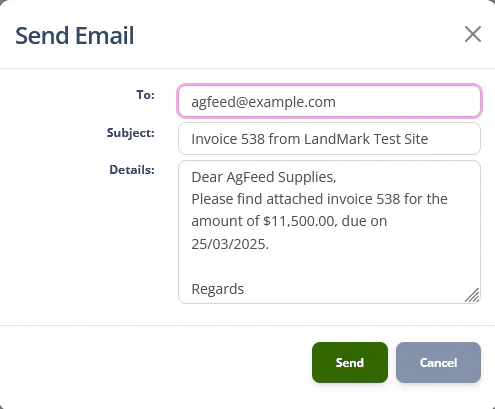
The system will pre-fill the field with information from the invoice and you may change this before sending the email.
When you are ready to send the email, click the “Send” button. The system will generate an email using the text you have entered, attach a printable copy of the invoice to the email, and send it to the recipient.
The system will also update the invoice Sent date to the current date and time.
When an invoice is in a Pro Forma state, executing the Issue action will remove the proforma status and update the Issue Date to the current date. This will also cause an invoice number to be assigned.
When an invoice has been issued, but it should not have been, the Credit action will reverse the effects of the invoice in the system. Each transaction related to the invoice is voided, which will reverse the financial effects of the invoice. The invoice is marked as credited and will be frozen.
When an invoice has been issued, but is incorrect, the Re-issue action will Credit the original invoice and generate a new copy of the invoice in a Pro Forma state. You can then update this new invoice as required and issue it to the customer when it is correct.